Perspective
The iPhone Duo: Apple Has Finally Entered the Fold - But the Bigger Story Is AI and the Mobile Workspace
Apple's first foldable iPhone is more than a hardware experiment. I see it as another signal that personal computing is moving toward AI-assisted, multi-app mobile work - and that privacy, governance and business workflow design will matter as much as the device itself.
The iPhone Duo: Apple Has Finally Entered the Fold - But the Bigger Story Is AI and the Mobile Workspace
Apple's first foldable iPhone is more than a hardware experiment. I see it as another signal that personal computing is moving toward AI-assisted, multi-app mobile work - and that privacy, governance and business workflow design will matter as much as the device itself.
By Loyiso Skweyiya | 9 September 2026 |
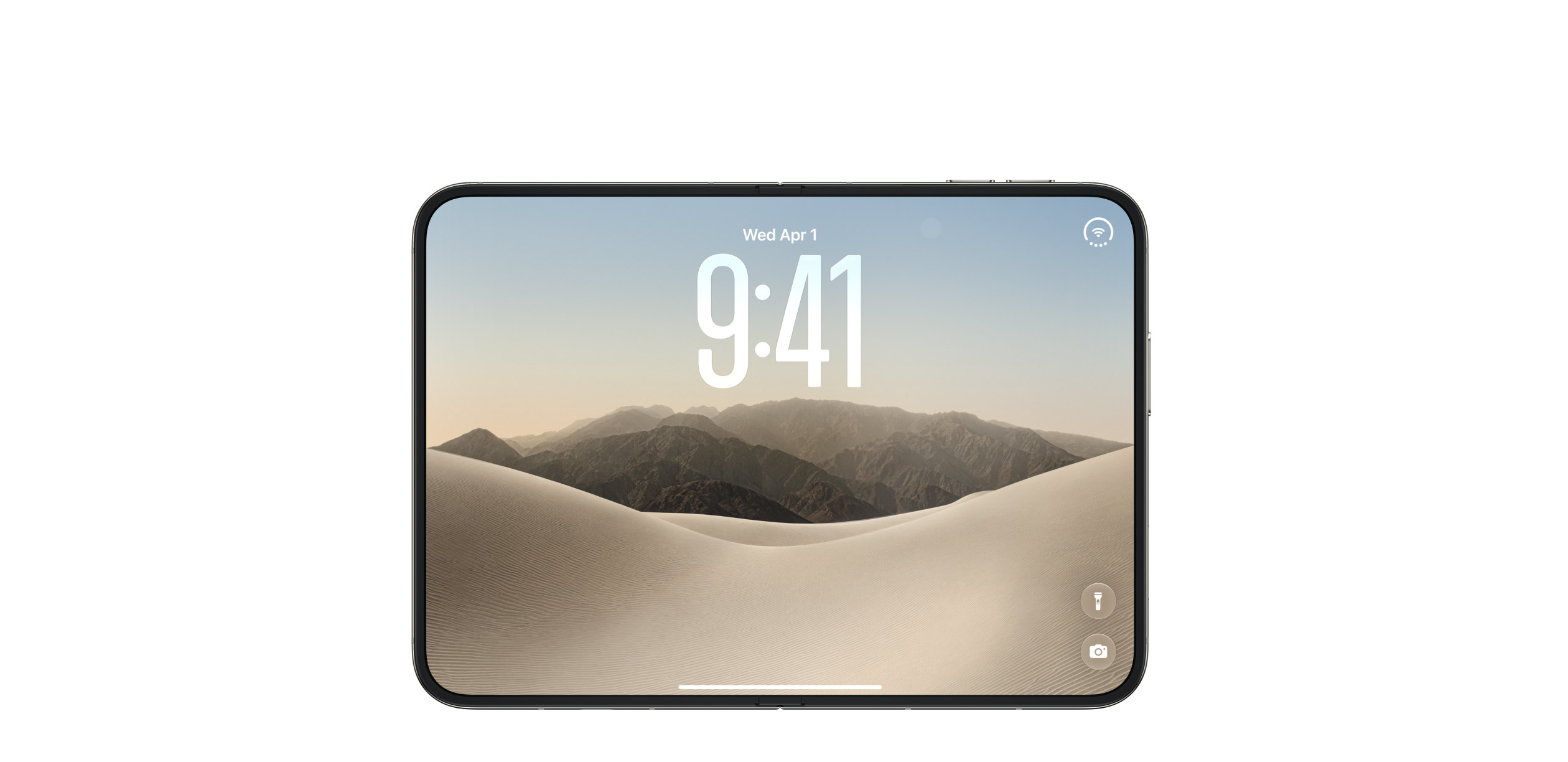
At Apple's event on 9 September 2026, the company finally did what the technology industry had anticipated for years: it unveiled its first foldable iPhone. It is officially called the iPhone Duo.
The Duo opens into a 7.6-inch inner display and uses a 5.4-inch outer display when closed. Apple has paired the new form factor with the A20 Pro processor, a version of iOS 27 tailored to the device, split-screen multitasking, Apple Intelligence and the new Siri AI experience. Apple Pencil support is due later in the year. The device starts at US$1,999 in the United States, with pre-orders scheduled for 16 October and availability from 23 October in Apple's initial markets.
There is plenty for the consumer technology world to discuss: the hinge, the titanium construction, the cameras, battery life, display durability and the inevitable comparisons with Samsung, Huawei and other foldable pioneers.
But those are not the things that interest me most.
I believe the iPhone Duo matters because it shows how AI, software and hardware are beginning to converge into a single intelligent mobile workspace. |
Apple is late to foldables - deliberately
Apple did not invent the foldable smartphone. Samsung and Huawei have been developing this category for years, and other manufacturers have followed. Foldables remain a relatively small part of the overall smartphone market, but the category is no longer experimental in the way it once was.
Apple's history suggests that being first is not always the objective. The company often enters a category after the underlying technology, manufacturing and user experience have matured enough for Apple to bring hardware and software together around a more mainstream proposition.
So the useful question is not whether Apple invented the foldable phone. It did not. The question is whether Apple can make the form factor useful enough that a much larger group of users begins to understand why a foldable device could change the way they work, communicate and consume information.
The most interesting feature is not the hinge
When the Duo is opened, iOS 27 can run two apps side by side on an iPhone for the first time. Apple also says users can open two windows of the same app, swap quickly between apps and save app pairings they want to return to later. Third-party applications including Slack and Zoom are already adapting to the larger canvas.
That sounds like a simple interface change until we look at it through the eyes of someone who increasingly works from a phone. A user could have a meeting or messaging application on one side and a document, browser, CRM or workflow system on the other. Apple Pencil support adds another layer for note-taking, sketching and document markup.
The smartphone has always been excellent at consuming information. It has been less efficient when work requires multiple contexts at the same time. The Duo starts to blur that distinction. For some users it could become less like a large phone and more like a pocket-sized work surface.
And then there is AI
This is where the announcement becomes more significant to me. Apple is positioning the Duo alongside a more capable Apple Intelligence stack and Siri AI. Apple says Siri can draw on personal context across messages, emails, photos and other information, understand what is on screen and take actions related to that context. On the Duo, a user can continue looking at content on one side of the display while interacting with Siri on the other.
The A20 Pro also matters because Apple is increasingly designing the device around on-device AI. Its Dual 16-core Neural Engine is intended to provide substantially more compute for local AI models, while Apple continues to use Private Cloud Compute for tasks that require greater cloud capacity.
That combination points toward a change in the way people may use AI. The first wave of Generative AI was largely application-based: open an AI tool, type a prompt, copy the output and move back into the business system where the work actually happens.
The next wave is increasingly contextual: the AI understands what the user is doing, works alongside the application, draws on permitted information and helps complete the task in the flow of work.
The shift I am watching is from AI as a destination to AI as an operating layer across the work itself. |
From Generative AI to Operational AI - and eventually Agentic AI
This distinction is important for businesses. Generative AI helps create or transform information. Operational AI begins to connect that intelligence to real business processes: customer service, sales, HR, procurement, field service, finance and internal operations. Agentic AI goes a step further by allowing software to reason across a workflow and take authorised actions on behalf of a user or organisation.
A foldable screen does not create those capabilities on its own. What it does is create a more usable mobile environment in which an employee can see the business context and the AI assistant at the same time.
Imagine a sales executive viewing a customer record while an AI assistant summarises the account history, surfaces an outstanding quotation, drafts a follow-up and prepares the next meeting notes. An HR manager could review a performance record while an assistant identifies incomplete reviews or prepares a management summary. A field technician could view instructions, capture photos and work with an AI troubleshooting assistant without constantly switching between screens.
Those scenarios require integration, permission design and good software architecture. They are not automatic features of the iPhone Duo. But the hardware is moving in a direction that makes this type of workflow more natural.
Why this matters for South African businesses
For South African organisations, the Duo should not be viewed only as a premium consumer device. It is a useful indicator of where enterprise mobility is heading. The bigger question is whether the applications we build and buy are ready for AI-assisted, multi-window, context-aware work.
Responsive design can no longer mean only making a website fit a smaller screen. Modern business applications increasingly need to support different screen states, touch, voice, AI interaction, simultaneous windows and workflows that can move across systems without losing context.
This is especially relevant in sectors where people work away from a traditional desk: field services, logistics, healthcare, professional services, sales, construction, agriculture, retail operations and many public-sector environments. A device that can operate as a compact phone and then open into a larger working canvas could be useful where carrying both a phone and a tablet is impractical.
The POPIA and governance question becomes more important, not less
There is another side to this progress. As AI becomes capable of drawing on emails, messages, calendars, photographs, documents and business applications, the privacy and governance questions become more serious.
Apple is making privacy central to its AI architecture, using on-device processing where possible and Private Cloud Compute for more demanding tasks. That is a meaningful technical direction, but no hardware purchase makes an organisation compliant with the Protection of Personal Information Act (POPIA).
South African businesses still need to understand what personal information an AI-enabled application can access, the purpose for which it is being processed, where that data may be processed, what third parties are involved, how access is authorised and how actions are audited. As AI becomes more agentic, identity, permissions, accountability and governance become as important as model intelligence.
That is why I believe AI adoption should be treated as an operating-model and governance programme, not simply as a software rollout.
The price means businesses should look for a real use case
The iPhone Duo starts at US$1,999 in the United States, making it a premium device. At the time of writing, I am not publishing a South African price because Apple had not provided a confirmed local retail price in the official material I reviewed.
For organisations, that means the business case should be based on productivity rather than novelty. If a device can replace part of the need for a separate tablet, improve field workflows, reduce application switching or enable a mobile professional to complete more work securely while away from a desk, the economics become more interesting. If it is being purchased only because it folds, the justification is much weaker.
The first generation will also need to prove itself in the real world. Durability, repairability, battery performance, application optimisation and long-term support will matter, especially for enterprise deployments.
What I think businesses should take from this
The announcement is bigger than Apple. It tells CIOs, digital leaders, software teams and technology service providers that the interface is changing again.
For years, organisations designed primarily for desktop and then adapted experiences to mobile. We are now moving into an environment of multiple screen states, AI-assisted workflows, voice interaction, contextual computing and agents capable of taking controlled actions across applications.
That is directly relevant to the work we are pursuing at A2Z Communications. When we discuss AI assistants, chatbots, workflow automation, Generative AI, Operational AI and Agentic AI with customers, I do not see these as isolated technologies. They are becoming part of the broader digital operating environment through which people will work.
The most valuable projects will therefore not begin with the question, 'Which AI tool should we buy?' They will begin with the operational problem: Which process is slow? Where is information fragmented? Which employee is switching between too many systems? Which customer interaction should be faster? Which decision can be supported safely by AI? Then we design the technology around the outcome.
My perspective
I do not think the iPhone Duo succeeds simply because Apple finally made an iPhone that folds. And I would not recommend that every business rush out and buy one.
What makes the Duo interesting is the combination of a larger adaptive canvas, true side-by-side multitasking, on-device AI capability, contextual Siri, cameras that AI can interpret and software designed to understand more of what the user is doing.
Together, those developments point toward a future in which the smartphone becomes less of a collection of isolated applications and more of an intelligent operating environment.
The next major technology battle may not be about who builds the best phone. It may be about who builds the most useful personal AI computing environment - and how safely that environment connects people to the information, systems and workflows around them. |
On 9 September 2026, Apple did more than fold an iPhone. It opened another window into what the AI-powered mobile workplace could become.
Sources and further reading
• Apple Newsroom - Apple unveils iPhone Duo (9 September 2026)
• Apple - iPhone Duo product page
• Apple - September 2026 event stream
• Associated Press - coverage of Apple's September 2026 iPhone launch
• South African Government - Protection of Personal Information Act 4 of 2013
About the author
Loyiso Skweyiya is the Managing Director of A2Z Communications. His perspectives explore how emerging technologies - particularly Generative AI, Operational AI and Agentic AI - can be applied to practical business use cases, digital operations and customer experience.